
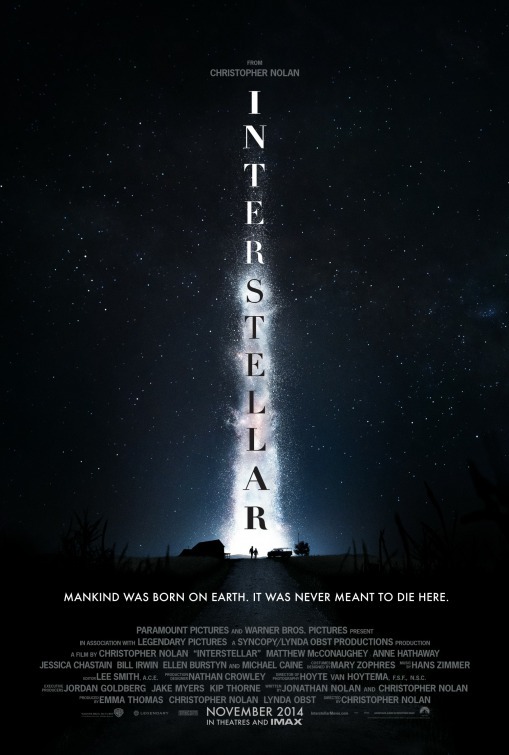
Interstellar
Scientificically accurate depiction of black hole — oh, btw a masterpiece by Christopher Nolan
Metadata
| Director | Christopher Nolan |
| Year | 2014 |
| Writer | Jonathan Nolan, Christopher Nolan |
| Stars | Matthew McConaughey, Anne Hathaway, Jessica Chastain |
The Movie in 3 Sentences
Cooper, a former pilot turned farmer, leaves a dying Earth on a mission to find a new home for humanity. His journey takes him through wormholes, distant planets, black holes, and extreme time dilation, while every decision pulls him further away from his daughter, Murph, whose life on Earth eventually becomes inseparable from the same mission.
I’ve watched this movie many times, both in theaters and at home, and so many of its images are still burned into my memory: the black hole, the fifth-dimensional tesseract, Cooper desperately trying to communicate with his past self through the bookshelf, the strange planets he visits, even the dust storms back on Earth. Very few movies leave me with that many scenes I can still picture so clearly years later.
What makes Interstellar endure for me, though, is how it combines those enormous ideas with something deeply human. It is about space, time, survival, and the unknown, but also about love, sacrifice, regret, and the terrible cost of leaving someone behind for a greater purpose. The scale is cosmic, yet the emotional core is always intimate.
The visuals are breathtaking, Hans Zimmer’s score is haunting, and the story works on both an emotional and philosophical level. This movie made me cry—not only because it is sad, but because there is something genuinely overwhelming about its beauty and ambition.