
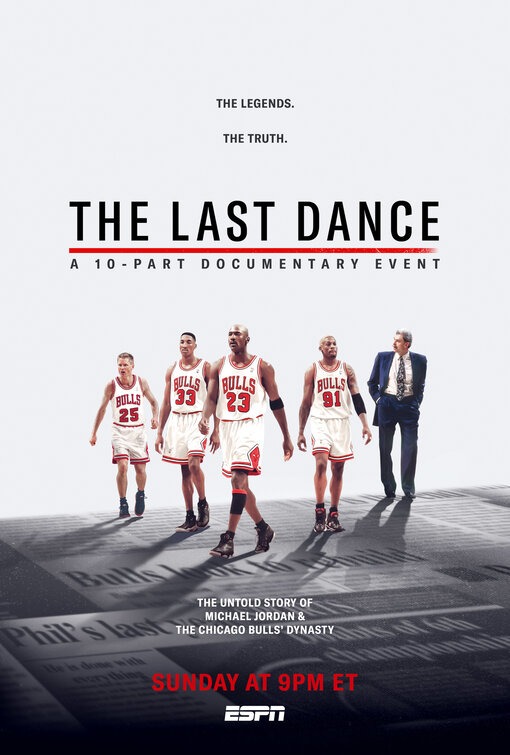
The Last Dance
Led by Michael Jordan, the 1990s Chicago Bulls establish themselves as one of the most notable dynasties in sports history.
Metadata
| Stars | Michael Jordan, Scottie Pippen, Dennis Rodman, Phil Jackson |
| Creators | Jason Hehir |
The Show in 3 Sentences
I remember the Chicago Bulls being a huge deal when I stayed with my cousins in Chicago in the ’90s. At the time, I mostly thought it was strange that a basketball player was starring in an animated movie, and Michael Jordan seemed almost like a larger-than-life celebrity joke to me. I was never much of a sports fan, so I knew Jordan mostly as a “big name.” The Last Dance completely changed that—not just how I saw him and the Bulls, but how I thought about basketball as a sport, a team, and even a kind of philosophy.
One of my favorite moments is when Steve Kerr—an intelligent, thoughtful guy raised by two academics—is asked what made that particular dynasty so unique. You can almost see him searching for the deeper answer the question seems to demand: team chemistry, discipline, leadership, shared purpose. But after struggling for the right words, he finally just laughs and says, “We’ve got Michael.” And somehow that says everything. If you didn’t live through that era, the documentary makes you understand the scale of it. If you did, it makes you grateful you got to witness it.
What surprised me most was how much my feelings about Jordan changed on a personal level. With so much archival footage and so many people describing him from different angles, his humanity becomes impossible to avoid—the competitiveness, cruelty, insecurity, humor, obsession, and vulnerability all sitting alongside the greatness. I started with Michael Jordan the icon and ended up feeling like I had gotten to know Michael Jordan the person. And once that happens, basic human compassion kicks in; he becomes far more complicated and much more interesting than the mythology around him.
But beyond Jordan, the person I found myself wanting to learn more about was Phil Jackson. Teams that extraordinary rarely happen through talent alone. Behind all that brilliance, ego, conflict, and pressure, there had to be someone capable of holding the whole thing together.